Project Overview
As a first-year member of the University of Toronto FSAE team, I was tasked with creating a CAD model of our radiator for the UT22 vehicle. Having no prior experience with SolidWorks, this was my introduction to 3D modeling. It took about a week to complete this relatively simple radiator CAD, but it laid the foundation for my future SolidWorks learning and mechanical design skills.

SolidWorks model of the UT22 radiator assembly
What I Did
The team needed a basic 3D model of the radiator for packaging studies. Starting from engineering drawings, I learned the basics of SolidWorks to create a simple parametric model of the radiator assembly, including the core, tanks, and mounting points.
Learning Experience
This project taught me fundamental CAD skills: creating basic shapes, using extrusions and cuts, working with assemblies, and generating simple drawings. Though straightforward, it built confidence and established me as someone who could handle CAD work for the team.
Key Achievements
- Created the team's first radiator CAD model
- Learned SolidWorks basics in one week
- Provided model for vehicle packaging analysis
- Started my CAD learning journey
Technologies Used
Impact
This simple project was my entry point into mechanical design. It demonstrated that I could learn new software quickly and deliver useful CAD work, leading to more responsibilities in future FSAE projects. The radiator model was used for basic packaging checks and helped the team understand space constraints.
Related FSAE Projects

2023 Cooling System Design
2023Initial cooling system architecture and component selection.
Impact: Designed complete cooling loop for a first year electric FSAE vehicle, ensuring adequate thermal management for motor and battery systems under competition conditions
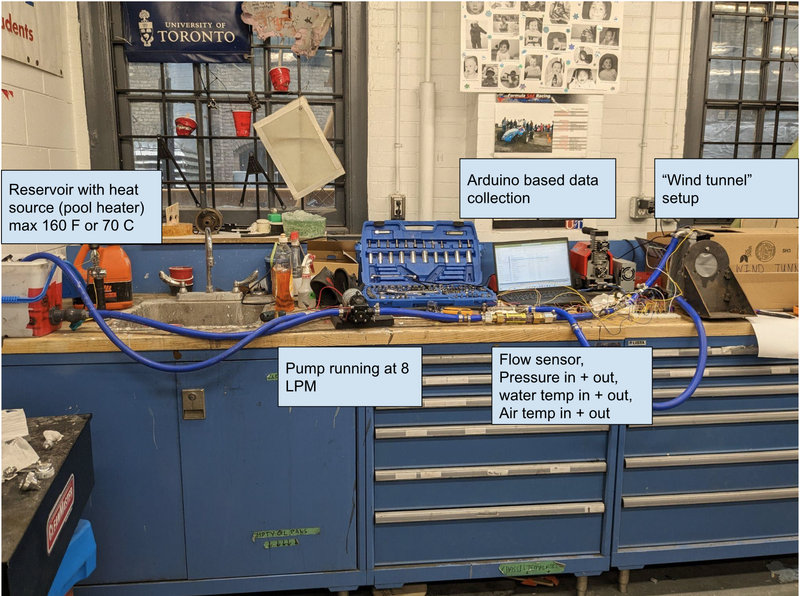
Radiator Characterization & Testing
2024Designed and built UTFR's first comprehensive radiator characterization test bench with custom circuit board for data acquisition, featuring 1 flow rate sensor, 2 pressure sensors, 2 water temperature sensors, 2 air temperature sensors, and hot wire anemometer - all logged directly to computer. This marked the first experimental radiator testing in team history and generated valuable thermal performance data.
Impact: Established experimental thermal testing capabilities and generated comprehensive radiator performance database for CFD validation and cooling system design

2024 Cooling System Design & Thermal Optimization
2024Advanced thermal management optimization using CFD analysis and experimental validation, building on the 2023 foundation with significantly improved routing and component placement to achieve 10% cooling efficiency improvement and 5°C temperature reduction.
Impact: Achieved 10% cooling efficiency improvement and 5°C motor temperature reduction through CFD-driven design optimization