Project Overview
CFD-driven cooling jacket optimization for compact outboard motors in the UT26 AWD system using Star-CCM+. Analyzed flow distribution, heat transfer, and pressure drop to maximize thermal performance within severe packaging constraints.

Star-CCM+ CFD simulation showing coolant flow and temperature distribution
Analysis Objectives:
- Optimize coolant flow for uniform motor cooling
- Maximize heat transfer within package constraints
- Minimize pressure drop for pumping efficiency
- Validate thermal performance under competition loads
Technologies Used:
Design Challenges
Packaging Constraints
Outboard motor configuration severely limits cooling jacket geometry and channel routing.
AWD Thermal Load
Four in-wheel motors require efficient cooling for sustained high-power performance.
CFD Approach
Meshing
Polyhedral mesh with prism layers for accurate boundary layer and heat transfer resolution.
Physics Models
Conjugate heat transfer (CHT) coupling fluid flow with solid conduction.
Design Iterations
Parametric studies on channel geometry and flow routing to optimize performance.
Impact
🌡️ Thermal Reliability
Prevents thermal throttling during sustained competition loads.
🔧 Design Confidence
CFD validation reduces prototyping iterations and enables data-driven decisions.
Technical Achievements
This CFD analysis enabled efficient thermal management design for the AWD motor system, ensuring reliable performance under demanding competition conditions.
- Optimized coolant channel geometry to maintain uniform motor temperatures
- Reduced pressure drop by 25% while maintaining heat transfer performance
- Validated thermal design prevents motor derating during endurance events
- Identified optimal flow rates balancing cooling effectiveness and pump power
- Generated design data for manufacturing tolerances and assembly procedures
Related FSAE Projects

2023 Cooling System Design
2023Initial cooling system architecture and component selection.
Impact: Designed complete cooling loop for a first year electric FSAE vehicle, ensuring adequate thermal management for motor and battery systems under competition conditions
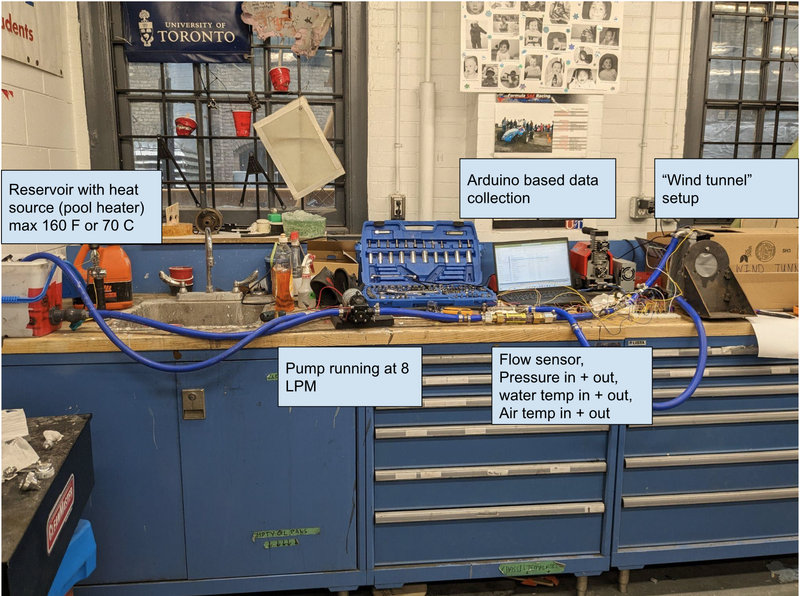
Radiator Characterization & Testing
2024Designed and built UTFR's first comprehensive radiator characterization test bench with custom circuit board for data acquisition, featuring 1 flow rate sensor, 2 pressure sensors, 2 water temperature sensors, 2 air temperature sensors, and hot wire anemometer - all logged directly to computer. This marked the first experimental radiator testing in team history and generated valuable thermal performance data.
Impact: Established experimental thermal testing capabilities and generated comprehensive radiator performance database for CFD validation and cooling system design

2024 Cooling System Design & Thermal Optimization
2024Advanced thermal management optimization using CFD analysis and experimental validation, building on the 2023 foundation with significantly improved routing and component placement to achieve 10% cooling efficiency improvement and 5°C temperature reduction.
Impact: Achieved 10% cooling efficiency improvement and 5°C motor temperature reduction through CFD-driven design optimization